Gene-Edited Wheat For Sustainable Farming
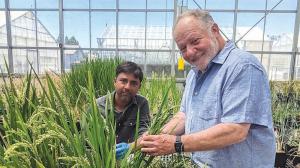 ✖  |
Scientists at the University of California, Davis, led by Distinguished Professor Eduardo Blumwald, have pioneered a breakthrough technology that could create wheat crops that fertilize themselves, dramatically reducing farmers’ reliance on chemical fertilizers and reducing global pollution.
By harnessing the CRISPR gene-editing tool, Blumwald’s team has enabled wheat plants to produce more of a naturally occurring chemical, which then stimulates soil bacteria to convert atmospheric nitrogen (N) into a form usable for plant growth. This process, known as nitrogen fixation, is common in legumes but has so far eluded cereals like wheat.
Legumes such as beans and peas have root nodules that house nitrogen-fixing bacteria in low-oxygen environments. This symbiotic relationship is why legumes require less nitrogen fertilizer.
“For 50 years, scientists have tried to bring N-fixing bacteria (engineered or modified) inside the plant, somehow trying to emulate the strategy that legumes use,” Blumwald explains. “This strategy (nodules, symbiosis) doesn’t work in cereals because of many reasons. Mainly, cereals can’t make nodules in their roots. These nodules are critical, because they’re full of leg-hemoglobin that can bind oxygen, thus generating conditions where the very low oxygen concentrations can’t harm the bacterial nitrogenase, as the bacteria live inside the nodules.”
Blumwald’s insight was to alter the approach. Instead of forcing bacteria into cereal roots, he focused on encouraging bacteria in the surrounding soil to fix nitrogen, and the ammonium (which contains the fixed nitrogen from the air) could diffuse through the soil into the roots. The team screened nearly 3,000 plant-produced chemicals, narrowing the field to 20 that could promote bacterial biofilm formation. Biofilms, covered in a substance impermeable to oxygen, protect the critical nitrogenase enzyme.
“It wasn’t easy,” Blumwald proclaims. “I found two, and I centered on apigenin.”
Using CRISPR, the team engineered wheat to produce excess apigenin, a flavone released through roots that stimulates bacteria to build protective biofilms. Experimental results are promising. Wheat plants grown with limited nitrogen fertilizer but engineered to produce apigenin showed higher yields than their unmodified counterparts.
The potential impact is enormous, especially in developing countries where the cost of fertilizer restricts crop yields.
“In Africa, people don’t use fertilizers because they don’t have money, and farms are small, not larger than six to eight acres,” Blumwald says. “Imagine planting crops that stimulate bacteria in the soil to create the fertilizer the crops need, naturally. Wow, that’s a big difference!”
Wheat is the world’s second most important cereal crop and accounts for about 18% of all nitrogen fertilizer use. In 2020, more than 800 million tons of fertilizer were produced worldwide. American farmers alone spent $36 billion on fertilizers last year, planting nearly 500 million acres of cereals. This innovation promises not only cost savings for farmers but also environmental benefits, such as reduced water pollution, less ozone layer depletion, and improved food security.
“This breakthrough will contribute to the reduction of inorganic N fertilizers,” Blumwald claims. “There will be plenty of money savings, a reduction of eutrophication of our waters, and a reduction in the depletion of the ozone layer by nitrous oxide (produced by denitrification of the inorganic N fertilizer in the soil). If we could save 10% (I’m calculating conservatively) of the amount of fertilizer used on that land, it should be a savings of more than a billion dollars every year.”
Building on earlier work with rice, Blumwald’s team is now extending this technology to other cereals, including maize and sorghum. If successful, gene-edited crops could soon usher in a new era of sustainable agriculture — where plants help feed themselves, farmers save money, and the environment benefits.
Contact: FARM SHOW Followup, Dr. Eduardo Blumwald, UC-Davis, 1119 PRB Bldg., One Shields Ave., Davis, Calif. 95616 (eblumwald@ucdavis.edu).

Click here to download page story appeared in.
Click here to read entire issue
Gene-Edited Wheat For Sustainable Farming
Scientists at the University of California, Davis, led by Distinguished Professor Eduardo Blumwald, have pioneered a breakthrough technology that could create wheat crops that fertilize themselves, dramatically reducing farmers’ reliance on chemical fertilizers and reducing global pollution.
By harnessing the CRISPR gene-editing tool, Blumwald’s team has enabled wheat plants to produce more of a naturally occurring chemical, which then stimulates soil bacteria to convert atmospheric nitrogen (N) into a form usable for plant growth. This process, known as nitrogen fixation, is common in legumes but has so far eluded cereals like wheat.
Legumes such as beans and peas have root nodules that house nitrogen-fixing bacteria in low-oxygen environments. This symbiotic relationship is why legumes require less nitrogen fertilizer.
“For 50 years, scientists have tried to bring N-fixing bacteria (engineered or modified) inside the plant, somehow trying to emulate the strategy that legumes use,” Blumwald explains. “This strategy (nodules, symbiosis) doesn’t work in cereals because of many reasons. Mainly, cereals can’t make nodules in their roots. These nodules are critical, because they’re full of leg-hemoglobin that can bind oxygen, thus generating conditions where the very low oxygen concentrations can’t harm the bacterial nitrogenase, as the bacteria live inside the nodules.”
Blumwald’s insight was to alter the approach. Instead of forcing bacteria into cereal roots, he focused on encouraging bacteria in the surrounding soil to fix nitrogen, and the ammonium (which contains the fixed nitrogen from the air) could diffuse through the soil into the roots. The team screened nearly 3,000 plant-produced chemicals, narrowing the field to 20 that could promote bacterial biofilm formation. Biofilms, covered in a substance impermeable to oxygen, protect the critical nitrogenase enzyme.
“It wasn’t easy,” Blumwald proclaims. “I found two, and I centered on apigenin.”
Using CRISPR, the team engineered wheat to produce excess apigenin, a flavone released through roots that stimulates bacteria to build protective biofilms. Experimental results are promising. Wheat plants grown with limited nitrogen fertilizer but engineered to produce apigenin showed higher yields than their unmodified counterparts.
The potential impact is enormous, especially in developing countries where the cost of fertilizer restricts crop yields.
“In Africa, people don’t use fertilizers because they don’t have money, and farms are small, not larger than six to eight acres,” Blumwald says. “Imagine planting crops that stimulate bacteria in the soil to create the fertilizer the crops need, naturally. Wow, that’s a big difference!”
Wheat is the world’s second most important cereal crop and accounts for about 18% of all nitrogen fertilizer use. In 2020, more than 800 million tons of fertilizer were produced worldwide. American farmers alone spent $36 billion on fertilizers last year, planting nearly 500 million acres of cereals. This innovation promises not only cost savings for farmers but also environmental benefits, such as reduced water pollution, less ozone layer depletion, and improved food security.
“This breakthrough will contribute to the reduction of inorganic N fertilizers,” Blumwald claims. “There will be plenty of money savings, a reduction of eutrophication of our waters, and a reduction in the depletion of the ozone layer by nitrous oxide (produced by denitrification of the inorganic N fertilizer in the soil). If we could save 10% (I’m calculating conservatively) of the amount of fertilizer used on that land, it should be a savings of more than a billion dollars every year.”
Building on earlier work with rice, Blumwald’s team is now extending this technology to other cereals, including maize and sorghum. If successful, gene-edited crops could soon usher in a new era of sustainable agriculture — where plants help feed themselves, farmers save money, and the environment benefits.
Contact: FARM SHOW Followup, Dr. Eduardo Blumwald, UC-Davis, 1119 PRB Bldg., One Shields Ave., Davis, Calif. 95616 (eblumwald@ucdavis.edu).
To read the rest of this story, download this issue below or click
here to register with your account number.


